 Stack
Things vs OmniFocus (2026): which pay-once licence to buy
Both are task managers for Apple devices still sold as a one-time purchase, and both vendors say so in writing. Things 3 is three separate purchases, $49.99 for Mac, $9.99 for iPhone and $19.99 for iPad, with free sync and no subscription anywhere in the offer. OmniFocus 4 is one universal licence, $74.99 for Standard or $149.99 for Pro, sold beside a $99.99 yearly subscription and a web app that licence owners pay $49.99 a year for. This comparison reads both vendors' pricing, trial, refund and licence pages as of October 10, 2026 and sets the terms side by side. It is a documentation comparison; neither app was graded in use.
 4.1Things 3
 4.1OmniFocus 4
Specification by specification
| Spec | Things 3 | OmniFocus 4 |
|---|---|---|
| One-time price | $49.99 Mac, $9.99 iPhone and Watch, $19.99 iPad; $79.97 for all three | $74.99 Standard or $149.99 Pro, universal |
| What one purchase covers | One platform, unlimited devices of that kind; Family Sharing up to six | Mac, iPhone, iPad, Watch and Vision in one; household use by direct family |
| Subscription option | None; vendor states there are no subscriptions | $99.99 per year, includes Pro and web |
| Web or non-Apple access | None; Windows, Android and browsers not supported | Web app, $4.99 per month or $49.99 per year for licence owners |
| Free trial | 15 days from first launch, Mac only | 14 days, fully functional, Mac, iOS and web |
| Refund window | Apple's rules only; vendor cannot refund | 30-day return guarantee, Omni store and Apple stores; none on subscriptions |
| Minor updates | Free for the life of version 3 | All 4.x updates included |
| Major version upgrade | New purchase; price not published; Things 3 was paid for Things 2 owners | Paid, discounted; App Store shows $37.49 Standard and $74.99 Pro from v1 to v3 |
| Feature tiers | One tier | Standard and Pro; Pro adds Focus, custom perspectives, Forecast tag, automation |
| Sync | Things Cloud, free | Omni Sync, free and encrypted |
| Education discount | None; vendor refers to Apple programmes | Mac apps via educational store; not for App Store or subscriptions; percentage not published |
| System requirements | macOS 13.3+, iOS and iPadOS 16.4+ | macOS 15.2+, iOS and iPadOS 18.2+, visionOS 2.2+, watchOS 11.2+ |
| Verified ratings (US App Store) | iPhone 28K at 4.8; iPad 12K at 4.9; Mac too few to show | 341 at 4.0 (universal listing) |
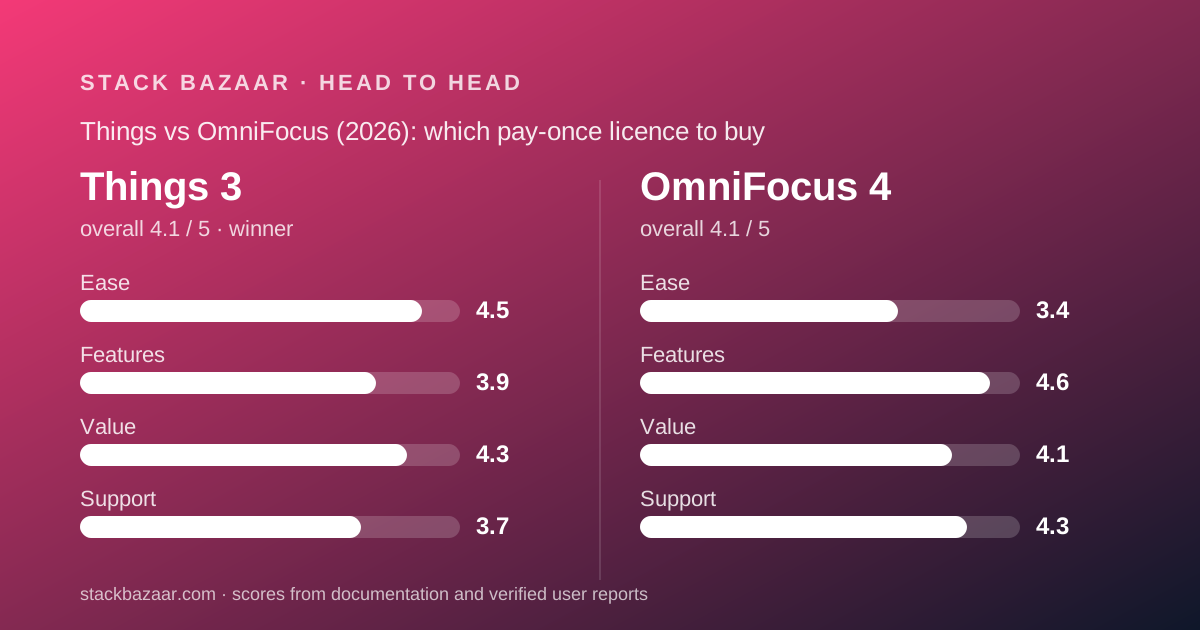
| Our ease / features / value / support | 4.5 / 3.9 / 4.3 / 3.7 | 3.4 / 4.6 / 4.1 / 4.3 |
The short answer
Things is the better pay-once purchase for most people, because every term is simpler and the entry price is $9.99. OmniFocus is the right licence when you need saved views across many projects, a browser on a work PC, or a 30-day return window that covers the App Store.
- Things is best for an Apple-only worker who wants one personal list, bought once per device type, synced free, shared with family, and never upsold.
- OmniFocus is best for a heavy planner who will use custom perspectives and review cycles, wants one universal licence across five Apple platforms, and may need the web app.
- Winner on licence terms: Things, on simplicity and total cost. Winner on scope: OmniFocus, on universal coverage and features. Both vendors state in writing that the licence is perpetual; this is a reading of those statements as of October 10, 2026, not a test of either app.
Things is three small purchases; OmniFocus is one universal licence
The first difference is the shape of the receipt, and it decides the arithmetic.
Things 3 is sold separately for Mac, iPad, iPhone and Vision, per the vendor's Getting Things page read October 10, 2026. The US App Store prices were $49.99, $19.99 and $9.99 for the first three, with the Watch app included in the iPhone purchase. A full set is $79.97 by the editors' arithmetic. There is no extra charge for a second device of the same kind.
OmniFocus 4 is one purchase. The buy page describes the v4 Standard licence at $74.99 and the Pro licence at $149.99 as universal, covering Mac, iPhone, iPad, Apple Watch and Apple Vision Pro, with all 4.x updates.
So an iPhone-only buyer pays $9.99 for Things and $74.99 for OmniFocus. A Mac-only buyer pays $49.99 against $74.99. Only a buyer who wants all three Apple apps gets close to parity, at $79.97 against $74.99, and that is before the Pro question. Full terms for each are in the Things 3 review and the OmniFocus 4 review.
Pricing: Things costs less at every step except the all-devices Standard case
Laying the October 10, 2026 figures in a row makes the pattern plain.
One device type: Things $9.99 to $49.99, OmniFocus $74.99. Two device types, say Mac and iPhone: Things $59.98, OmniFocus $74.99. Three device types: Things $79.97, OmniFocus $74.99 for Standard or $149.99 for Pro.
Add the web app and the gap reopens. OmniFocus licence owners who want browser access pay the web subscription, $4.99 a month or $49.99 a year, per the buy page. Things has no web app at any price, which is a limit rather than a saving, but it means Things's total is also its ceiling.
Neither vendor discounts. Cultured Code states it cannot offer student or business pricing. The Omni Group offers education pricing on Mac apps through its educational store, not for App Store purchases or subscriptions, and does not publish the percentage.
The method for reading these totals, including why the sticker price is the least important line, is in how to read a software deal before you pay.
OmniFocus also sells a subscription, and the licence still wins the sum
Things has nothing to compare here: the vendor's page says there are no subscriptions. OmniFocus does, and the buy page prices it beside the licence.
The OmniFocus subscription is $99.99 a year, includes Pro and web access, and promises no major version upgrade cost. By the editors' arithmetic the $74.99 Standard licence is cheaper before the subscription's first year ends, and the $149.99 Pro licence is cheaper during its second. A Pro licence plus the $49.99 web line is $199.98 in year one, level with two years of subscription, and ahead from year three.
The subscription has one structural advantage: the refund page states that refunds are not available for subscriptions, and the licence has a 30-day return guarantee. That is the opposite of an incentive to subscribe, and it is the clearest sign on either vendor's pages that the licence is the intended purchase.
The general rule for weighing a licence against the subscription it replaces is in how lifetime software deals actually work.
Trials: Things gives 15 days on the Mac only; OmniFocus gives 14 days everywhere
Both vendors publish their trial terms, and they are shaped differently.
Things offers a 15-day trial from first launch, downloaded from the vendor's site, on the Mac only. The Trying the App page explains there is no trial on iPhone, iPad or Vision because Apple permits trials only for apps with in-app purchases or subscriptions. Data entered during the trial is kept and picked up when you buy.
OmniFocus offers a 14-day fully functional trial that starts when you sign in with an Omni account, covering Mac, iOS and the web app, per the trial support page. Nothing is charged automatically, and after day 14 your data remains readable in a free viewer mode.
For an iPhone-first buyer this matters. With Things you buy the $9.99 app blind, which is a small risk. With OmniFocus you can run the full trial on the phone before paying $74.99. For a Mac-first buyer Things's extra day is immaterial and both trials are adequate.
Refunds: OmniFocus covers the App Store; Things hands you to Apple
This is the widest gap in the comparison, and it favours OmniFocus.
The Omni Group's refund policy, read October 10, 2026, offers a 30-day return guarantee for standalone licences bought from the Omni store or from Apple's App Store and Mac App Store, paid through PayPal on proof of purchase. Few vendors extend their own refund window to App Store sales; Omni does.
Cultured Code sells only through Apple and states that refunds must be requested from Apple. Its App Store troubleshooting page adds that a refund ends your ownership and update eligibility. Apple's refund process is discretionary and the vendor has no say in it.
Set against the rest of the magazine: Scrivener gives 30 days on its own store, TablePlus gives 7, and OmniFocus is the only product we have read that gives 30 on Apple's store too.
Features: OmniFocus documents far more; Things documents one tier and no web
On the vendors' own feature pages the gap is wide, and it is the reason OmniFocus's features score is the highest in the cluster.
OmniFocus Standard lists quick entry, inbox, projects, tags, flags, dates, repeats, notes, Forecast, Nearby, Review, customisable views, batch editing, notifications, widgets, a Watch app, free encrypted syncing and universal licensing. Pro adds Focus mode, custom perspectives, a Forecast tag and automation via Omni Automation plug-ins or Mac-only AppleScripts. A web app covers Android and PC.
Things documents a single tier with no Pro, no web app, no Windows or Android client and no team features, and a URL scheme as its published automation story. Its pages are about the design of a personal list rather than the breadth of a system.
The buyer's test is whether you can name the custom perspective you would build. If you can, OmniFocus Pro is the purchase. If you cannot, the extra features are a cost in complexity rather than a benefit, and Things's single tier is the point.
Ease of use: Things's ratings are stronger and its structure is simpler
Neither app was graded in use; the ease scores are read from structure and from verified ratings.
On October 10, 2026 the US App Store showed Things 3 for iPhone at 4.8 from 28K ratings and Things 3 for iPad at 4.9 from 12K. OmniFocus 4's universal listing showed 4.0 from 341 ratings. Apple publishes no star split, and the samples differ by two orders of magnitude, but the direction is consistent and we treat it as evidence.
Structure points the same way. Things has one tier, one price per platform, no web line and no subscription to decline. OmniFocus has two tiers, a subscription, a web add-on and an App Store in-app purchase list eight lines long. That is more to decide before the first task is entered.
The Trustpilot page for culturedcode.com returned a 404 and the omnigroup.com page showed no reviews, so there is no second verified source for either.
Updates and the next major version: both are paid, only OmniFocus prices the habit
Both licences include free updates within the current major version: all of Things 3, all of OmniFocus 4.x. Both vendors will charge for the next major version. The difference is in what each has published about the price.
OmniFocus's buy page promises upgrade discounts for future versions without a percentage, and the App Store listing shows the current habit: $37.49 to upgrade to Standard from versions 1 to 3 and $74.99 to Pro, half the full prices.
Things publishes no upgrade policy and no price. The last transition, from Things 2 to Things 3, was a new purchase, and the vendor's no-discounts statement applied. A buyer should assume full price per platform for a Things 4 at an unannounced date.
For a licence you intend to keep for years, the vendor's record matters more than the promise, as what happens after you pay once sets out. OmniFocus has a published half-price record; Things has a published full-price one. Both are honest; OmniFocus's is cheaper.
Support: OmniFocus publishes more commitments
Support is scored on written commitments, and OmniFocus has more of them.
The Omni Group publishes a trial page, a refund policy with a stated window and document list, a licensing page describing per-person and household scope, and an education page. Cultured Code publishes a support hub, articles on trying and getting the app, sync and App Store issues, and a contact page.
Neither vendor publishes a phone line, chat or response time on the pages read. The gap is that Omni's refund and licence terms are commitments a buyer can hold it to, and Cultured Code's purchase terms are, by design, Apple's.
Choose Things if, choose OmniFocus if
Conditions rather than conclusions, read from the October 10, 2026 pages.
- Choose Things if you start on the iPhone. $9.99 buys the app and the Watch app, and you can add the Mac later.
- Choose Things if you want the simplest licence in the cluster: one tier, no subscription, free sync, Family Sharing, no web line to add.
- Choose Things if your household shares an Apple family, since Family Sharing extends one set of purchases to six people.
- Choose OmniFocus if you need custom perspectives, review cycles or automation, and will pay $149.99 for Pro to get them.
- Choose OmniFocus if you need a browser at work. The web app costs $49.99 a year on top of the licence, but Things has nothing.
- Choose OmniFocus if the refund window matters. 30 days, from the Omni store or Apple's, against Apple's discretion alone for Things.
- Choose OmniFocus if you want every Apple device covered by one receipt, $74.99 for Standard against $79.97 for the Things set.
Frequently asked
Short answers, each from the pages read October 10, 2026.
- Is Things or OmniFocus cheaper? Things on one or two device types ($9.99 to $59.98 against $74.99). OmniFocus Standard by $4.98 if you want Mac, iPhone and iPad. OmniFocus Pro is $149.99, nearly double the full Things set.
- Does either have a subscription? Things does not; the vendor says so. OmniFocus sells a $99.99 yearly subscription beside the licence, and the licence is cheaper within a year by the editors' arithmetic.
- Can I use either on Windows? Neither has a Windows app. OmniFocus has a web app at $4.99 a month or $49.99 a year for licence owners. Things supports no non-Apple platform.
- Which has the better trial? OmniFocus for iPhone buyers, 14 days on every platform. Things for Mac buyers, 15 days, Mac only.
- Can I switch from Things to OmniFocus later? Both vendors' pages describe their own apps only; neither publishes an importer from the other on the pages read. Expect to rebuild the list by hand.
Bottom line
On published terms Things 3 is the cleaner pay-once licence: three fixed prices with a $9.99 entry, no subscription, free sync, Family Sharing, and free updates for the life of version 3. For most people who want a personal list on Apple devices it is the purchase.
OmniFocus 4 is the licence for the heavy planner: one universal $74.99 purchase, a feature set Things does not attempt, a web app for the office PC, a trial on every platform and a 30-day return window that covers the App Store. Its costs are complexity, a Pro tier at $149.99 and a $49.99 yearly web line.
Both, along with iA Writer, are ranked in the best pay-once productivity apps. Whichever you choose, run the trial first and buy the smallest unit that proves the habit.
Frequently asked
Is Things or OmniFocus cheaper to buy once?
Things on one or two device types: $9.99 for iPhone, $49.99 for Mac, $59.98 for both, against $74.99 for OmniFocus Standard. For Mac, iPhone and iPad together Things is $79.97 and OmniFocus Standard $74.99 (US App Store and Omni buy page, October 10, 2026).
Does Things or OmniFocus have a subscription?
Things does not; Cultured Code's Getting Things page states there are no subscriptions. OmniFocus sells a $99.99 yearly subscription beside its licences, per the buy page checked October 10, 2026. By the editors' arithmetic the $74.99 Standard licence is cheaper within the first year.
Can I use Things or OmniFocus on Windows or in a browser?
Things, no: the vendor lists Windows, Android, Linux and web browsers as unsupported. OmniFocus has a web app, sold to licence owners at $4.99 a month or $49.99 a year and included in the $99.99 subscription (buy page, October 10, 2026).
Which has the better free trial, Things or OmniFocus?
OmniFocus for anyone buying on iPhone or iPad: 14 days, fully functional, on Mac, iOS and web. Things offers 15 days on the Mac only and no trial on iPhone, iPad or Vision, because Apple permits trials only for apps with in-app purchases (vendor support pages, October 10, 2026).
Which has the better refund policy?
OmniFocus. Its refund policy, checked October 10, 2026, gives a 30-day return guarantee on standalone licences from the Omni store and from Apple's stores, though not on subscriptions. Things is sold only through Apple and the vendor states refunds must be requested from Apple.
Visit Things 3
We have no affiliate relationship with this vendor. Link goes to the official site.
Visit OmniFocus 4
We have no affiliate relationship with this vendor. Link goes to the official site.